Band Convolution
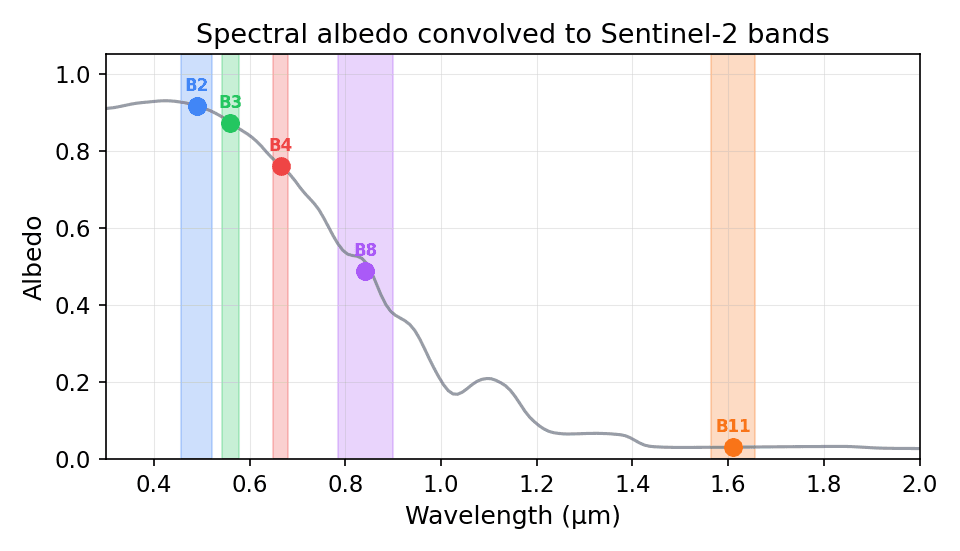
BioSNICAR outputs 480-band spectral albedo at 10 nm resolution. Satellites and climate models observe the surface through coarser spectral windows. The .to_platform() method maps the high-resolution spectrum onto platform-specific bands, enabling direct comparison between simulated and observed albedos.
Quick start
.to_platform() chains directly onto run_model():
from biosnicar import run_model

s2 = run_model(solzen=50, rds=1000).to_platform("sentinel2")
print(s2.B3)     # green-band albedo
print(s2.NDSI)   # Normalized Difference Snow Index

cesm = run_model(solzen=50, rds=1000).to_platform("cesm2band")
print(cesm.vis)  # VIS broadband albedo
print(cesm.nir)  # NIR broadband albedo
Supported platforms
| Platform | Key | Bands | Method | Use case |
|---|---|---|---|---|
| Sentinel-2 | sentinel2 | 13 | SRF convolution | High-resolution ice mapping |
| Sentinel-3 | sentinel3 | 21 | SRF convolution | Ocean and land colour |
| Landsat 8 | landsat8 | 7 | SRF convolution | Long-term ice monitoring |
| MODIS | modis | 7 + 3 broadband | Interval average | Global daily coverage |
| CESM 2-band | cesm2band | 2 | Interval average | Earth system modelling |
| CESM RRTMG | cesmrrtmg | 14 | Interval average | Detailed radiation schemes |
| MAR | mar | 4 | Interval average | Regional climate modelling |
| HadCM3 | hadcm3 | 6 | Interval average | Palaeoclimate modelling |
Spectral indices
Spectral indices are computed automatically where platform bands permit:
| Platform | Indices |
|---|---|
| Sentinel-2 | NDSI, NDVI, II (Impurity Index) |
| Sentinel-3 | I2DBA, I3DBA, NDCI, MCI, NDVI |
| Landsat 8 | NDSI, NDVI |
| MODIS | NDSI |
s2 = run_model(solzen=50, rds=1000, glacier_algae=50000).to_platform("sentinel2")
print(f"NDSI: {s2.NDSI:.3f}")
print(f"Impurity Index: {s2.II:.3f}")
Multi-platform comparison
A single Outputs object can be convolved onto multiple platforms:
outputs = run_model(solzen=50, rds=1000)
for plat in ["sentinel2", "landsat8", "modis", "cesm2band"]:
    r = outputs.to_platform(plat)
    print(f"{plat:12s}  bands: {len(r.band_names):2d}  indices: {r.index_names}")
With parameter sweeps
.to_platform() also works on sweep results, appending band columns to the DataFrame:
from biosnicar.drivers.sweep import parameter_sweep

df = parameter_sweep(
    params={"rds": [500, 1000], "solzen": [50, 60]},
).to_platform("sentinel2")

print(df[["rds", "solzen", "BBA", "B3", "NDSI"]])
For multiple platforms, columns are prefixed:
df = parameter_sweep(
    params={"rds": [500, 1000]},
).to_platform("sentinel2", "landsat8", "modis")

print(df[["rds", "sentinel2_NDSI", "landsat8_NDSI", "modis_NDSI"]])
GCM parameterisation
Generate band albedos for climate model radiation schemes:
cesm = run_model(solzen=60, rds=1000).to_platform("cesm2band")
print(f"CESM VIS: {cesm.vis:.4f}, NIR: {cesm.nir:.4f}")

mar = run_model(solzen=60, rds=1000).to_platform("mar")
print(f"MAR sw1: {mar.sw1:.4f}, sw2: {mar.sw2:.4f}")
Convolution methods
Two methods are used depending on the platform:
SRF convolution (satellite platforms)
Used by Sentinel-2, Sentinel-3, and Landsat 8. Each band has a Spectral Response Function (SRF) describing its wavelength sensitivity:
band_albedo = sum(albedo × SRF × flx_slr) / sum(SRF × flx_slr)SRFs are stored as CSV files in data/band_srfs/ and use tophat approximations by default. These can be replaced with official manufacturer SRFs for higher fidelity.
Flux-weighted interval averaging (GCMs and MODIS)
Used by CESM, MAR, HadCM3, and MODIS. The band albedo is the flux-weighted mean over all model grid points within the wavelength interval:
band_albedo = sum(albedo[lo:hi] × flx_slr[lo:hi]) / sum(flx_slr[lo:hi])Adding new platforms
New platforms can be added by providing a SRF CSV file in data/band_srfs/ with 480 rows (one per model wavelength) and one column per band, without modifying the core code.