Forward Model Examples
Basic usage
Run the model with default settings:
from biosnicar import run_model
import numpy as np

outputs = run_model()
print(f"Broadband albedo (BBA):  {outputs.BBA:.4f}")
print(f"Visible BBA:             {outputs.BBAVIS:.4f}")
print(f"NIR BBA:                 {outputs.BBANIR:.4f}")
print(f"Spectral albedo shape:   {np.array(outputs.albedo).shape}")
Override parameters
outputs = run_model(solzen=50, rds=1000)
print(f"BBA (solzen=50, rds=1000): {outputs.BBA:.4f}")
Add impurities
clean = run_model(solzen=50, rds=1000)
dirty = run_model(solzen=50, rds=1000, black_carbon=5000, glacier_algae=50000)

print(f"Clean ice BBA:      {clean.BBA:.4f}")
print(f"With impurities:    {dirty.BBA:.4f}")
print(f"Albedo reduction:   {clean.BBA - dirty.BBA:.4f}")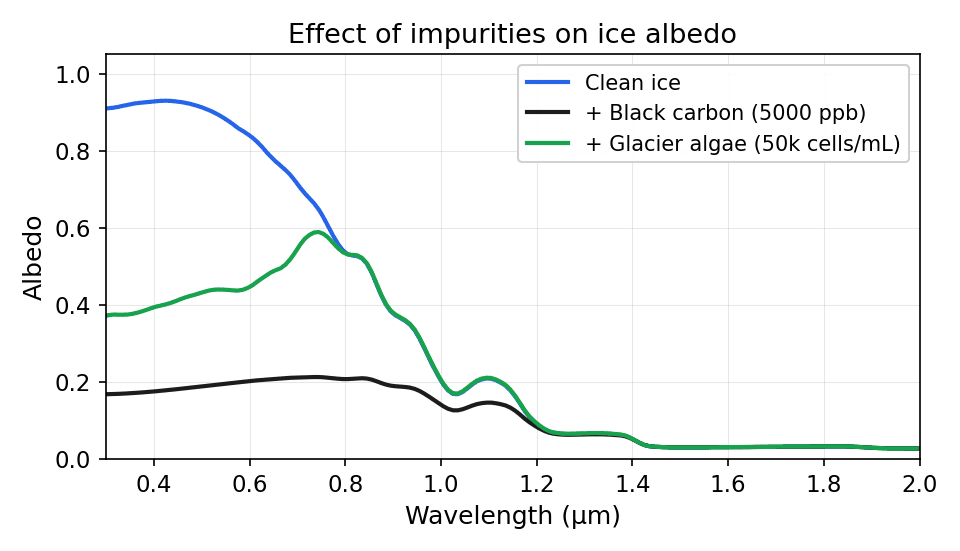
Multi-layer ice column
outputs = run_model(
    solzen=50,
    layer_type=[1, 1, 1, 1, 1],
    dz=[0.02, 0.05, 0.05, 0.05, 0.83],
    rds=[800, 900, 1000, 1100, 1200],
    rho=[500, 600, 700, 750, 800],
    glacier_algae=[40000, 10000, 0, 0, 0],
)
print(f"5-layer BBA: {outputs.BBA:.4f}")
Access spectral output
import numpy as np

outputs = run_model(solzen=50, rds=500)
albedo = np.array(outputs.albedo)
wavelengths = np.arange(0.205, 4.999, 0.01)

print(f"Albedo at 0.5 µm:  {albedo[29]:.4f}")
print(f"Albedo at 1.0 µm:  {albedo[79]:.4f}")
print(f"Albedo at 1.5 µm:  {albedo[129]:.4f}")
print(f"Min albedo:         {albedo.min():.4f} at {wavelengths[albedo.argmin()]:.2f} µm")
print(f"Max albedo:         {albedo.max():.4f} at {wavelengths[albedo.argmax()]:.2f} µm")
Parameter sweeps
from biosnicar.drivers.sweep import parameter_sweep

df = parameter_sweep(
    params={
        "solzen": [30, 40, 50, 60, 70],
        "rds": [100, 200, 500, 1000],
    }
)
print(df[["solzen", "rds", "BBA"]])
With satellite bands:
df = parameter_sweep(
    params={"rds": [500, 1000], "solzen": [50, 60]},
).to_platform("sentinel2")

print(df[["rds", "solzen", "BBA", "B3", "NDSI"]])
Subsurface light
import numpy as np
from biosnicar import run_model

depths = np.linspace(0, 0.5, 20)

clean = run_model(solzen=50, rds=500, dz=[0.01, 0.49])
dirty = run_model(solzen=50, rds=500, dz=[0.01, 0.49], glacier_algae=50000)

par_clean = clean.par(depths)
par_dirty = dirty.par(depths)

for d, pc, pd in zip(depths, par_clean, par_dirty):
    print(f"  {d:.3f} m   clean={pc:.4f}  algae={pd:.4f}")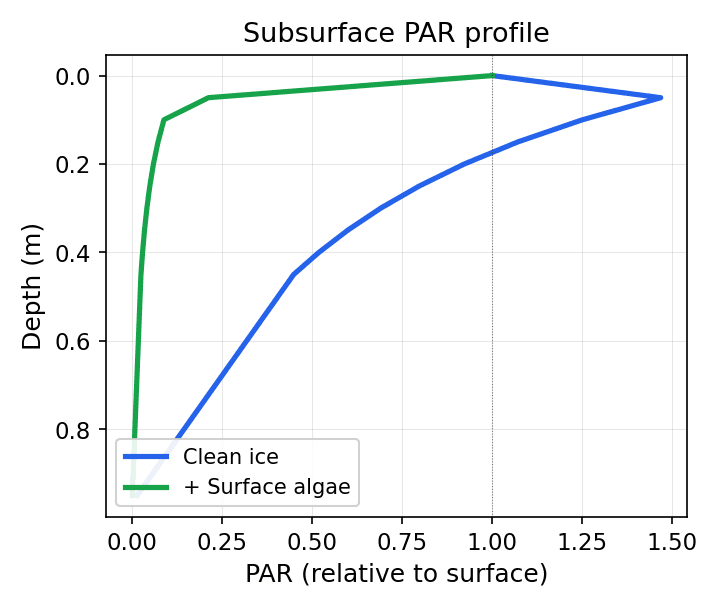
Spectral heating rates:
outputs = run_model(
    dz=[0.1]*20, rds=2000, rho=700, layer_type=[1]*20,
    solzen=50, glacier_algae=[50000] + [0]*19,
)
heating = outputs.spectral_heating_rate()
print(f"Heating rate shape: {heating.shape}")  # (480, 20)