Fast Emulator
BioSNICAR ships a pre-built neural-network emulator that reproduces the forward model at ~50,000x the speed (~1 µs vs ~50 ms per evaluation). It makes optimisation, MCMC, and real-time exploration practical — tasks that would take hours with the full radiative transfer solver finish in seconds.
We’ve also made it as easy as possible to build your own. Want a smaller emulator targeting a narrow parameter range for a specific field campaign? A larger one covering extreme impurity concentrations? A snow-only variant with 3 free parameters? One call to Emulator.build() handles the sampling, training, and export.
Use the default emulator
The repository includes an 8-parameter general-purpose emulator at data/emulators/glacier_ice_8_param_default.npz, trained on 50,000 Latin hypercube samples of solid glacier ice. It covers the most common use cases out of the box:
from biosnicar.emulator import Emulator
from biosnicar import run_emulator

# Load the pre-built emulator
emu = Emulator.load("data/emulators/glacier_ice_8_param_default.npz")

# Predict spectral albedo (~1 µs)
albedo = emu.predict(
    rds=1000, rho=600, black_carbon=5000, snow_algae=0, dust=1000,
    glacier_algae=50000, direct=1, solzen=50,
)

# Or get a full Outputs object (BBA, BBAVIS, BBANIR, .to_platform())
outputs = run_emulator(
    emu, rds=1000, rho=600, black_carbon=5000, snow_algae=0, dust=1000,
    glacier_algae=50000, direct=1, solzen=50,
)
print(outputs.BBA)
outputs.to_platform("sentinel2")
Default parameter ranges
| Parameter | Range | Units |
|---|---|---|
rds | 500–10,000 | µm |
rho | 300–900 | kg/m³ |
black_carbon | 0–5,000 | ppb |
snow_algae | 0–500,000 | cells/mL |
glacier_algae | 0–500,000 | cells/mL |
dust | 0–50,000 | ppb |
direct | 0–1 | binary flag |
solzen | 25–80 | degrees |
All 8 parameters must be provided when calling predict(). The emulator clips inputs to training bounds and warns if out of range.
Build your own
The default emulator is general-purpose, but you can do better for a specific task. Building a custom emulator is a single function call:
from biosnicar.emulator import Emulator

# Focused emulator: 4 free parameters, narrow ranges, fixed illumination
emu = Emulator.build(
    params={
        "rds": (100, 3000),
        "rho": (300, 700),
        "black_carbon": (0, 50000),
        "glacier_algae": (0, 200000),
    },
    n_samples=5000,
    layer_type=1,       # fixed: solid ice
    solzen=50,          # fixed
    direct=1,           # fixed
)
emu.save("my_field_campaign.npz")
Any run_model() keyword can be a free parameter (in params) or fixed (as a keyword argument). Fewer free parameters means fewer training samples needed and higher accuracy for the same build time.
Some ideas:
- Snow-only emulator — set
layer_type=0, use snow-relevantrdsrange (50–2000 µm), fix impurities to zero - High-impurity emulator — extend
black_carbonto 100,000 ppb for heavily polluted sites - Fixed-illumination emulator — lock
solzenanddirectfor a specific scene, freeing up capacity for ice parameters - Minimal 2-parameter emulator — just SSA and one impurity, for fast field retrievals with everything else known
Build time
| Samples | Time | Storage | Use case |
|---|---|---|---|
| 5,000 | ~4 min | ~100 KB | 2–4 free parameters |
| 10,000 | ~8 min | ~150 KB | 4–5 free parameters |
| 15,000 | ~12 min | ~180 KB | 6+ free parameters |
| 20,000 | ~17 min | ~200 KB | High-accuracy applications |
Build time is dominated by forward model runs (~50 ms each). MLP training adds < 10 seconds.
Requires
scikit-learn>=1.0at build time. Loading a pre-built emulator requires only NumPy.
Verify accuracy
result = emu.verify(n_points=50)
print(result.summary())
verify() runs the forward model on held-out parameter sets and compares against emulator predictions, reporting MAE, max error, R², and per-point diagnostics.
Why an emulator?
The forward model takes ~50 ms per evaluation. Many important workflows require thousands to millions of evaluations:
| Task | Evaluations | Forward model | Emulator |
|---|---|---|---|
| Direct optimisation | 100–500 | 5–25 s | < 100 ms |
| Global optimisation | 500–5,000 | 25 s – 4 min | < 1 s |
| MCMC (32 walkers x 5000 steps) | 160,000 | ~2.2 hours | ~1 minute |
The emulator is what makes the inverse retrieval module practical.
Accuracy
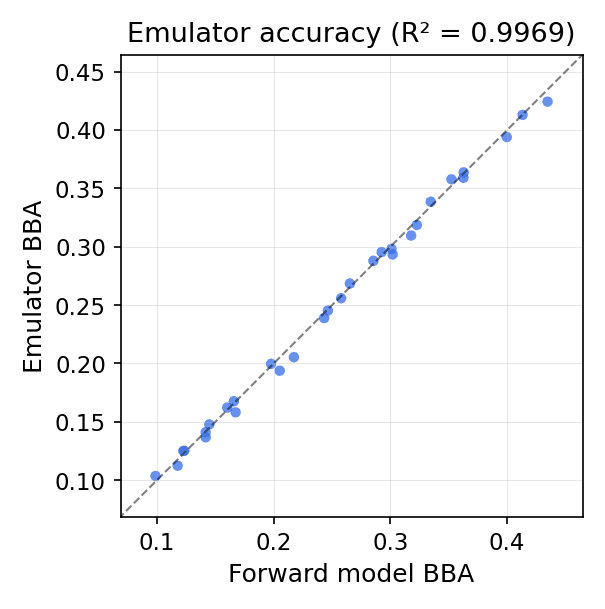
- R² > 0.999 with 5,000+ training samples
- MAE < 0.005 albedo units
- Max broadband error < 0.01
Architecture
PCA compresses the 480-band output to ~10 principal components, and a small MLP (128-128-64 neurons, ReLU) predicts these coefficients. The result is a ~150 KB .npz file — no TensorFlow, no PyTorch, no GPU. Just three matrix multiplications and a ReLU.
The .npz format is version-independent, safe to share (no pickle), and human-inspectable with np.load().
For full architecture details, see Design Rationale. For building custom emulators, see Building Emulators.