Remote Sensing
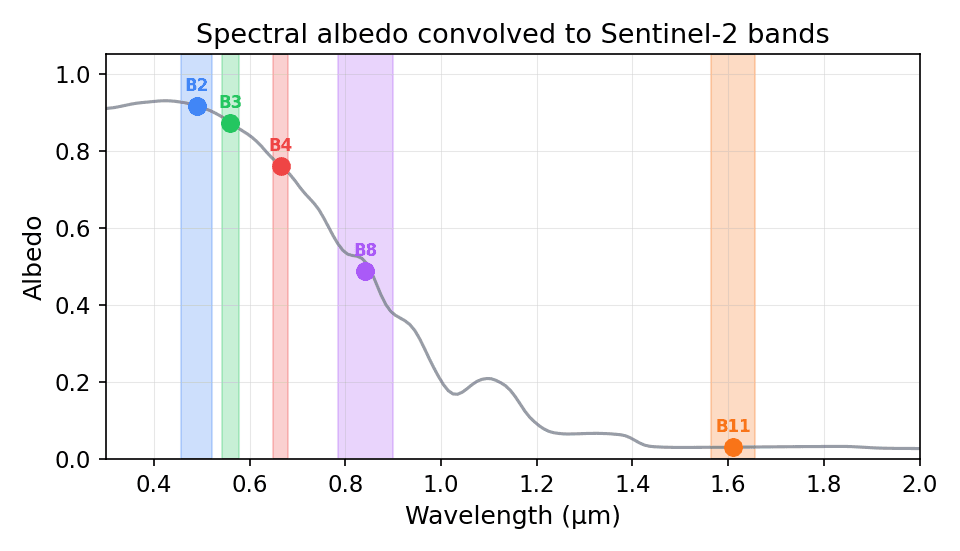
BioSNICAR bridges the gap between high-resolution radiative transfer modelling and real-world observations. The model outputs 480 spectral bands, but satellites measure a handful of broadband values and field spectrometers measure continuous spectra. This section covers two capabilities that connect model output to observational data:
- Band convolution — map 480-band spectral output onto satellite and climate model bands
- Inverse retrieval — estimate ice properties from observed albedo
Together, they enable a workflow that goes from satellite pixel to physical interpretation in under a second.
The integrated workflow
from biosnicar.emulator import Emulator
from biosnicar.inverse import retrieve
import numpy as np

# Load emulator
emu = Emulator.load("data/emulators/glacier_ice_8_param_default.npz")

# Sentinel-2 band values from a glacier pixel
obs = np.array([0.82, 0.78, 0.75, 0.45, 0.03])
bands = ["B2", "B3", "B4", "B8", "B11"]

# Retrieve ice properties
result = retrieve(
    observed=obs,
    parameters=["ssa", "black_carbon", "glacier_algae"],
    emulator=emu,
    platform="sentinel2",
    observed_band_names=bands,
    fixed_params={"direct": 1, "solzen": 50, "dust": 1000, "snow_algae": 0},
)
print(result.summary())