Remote Sensing Examples
Map to satellite bands
Chain .to_platform() onto any model run:
from biosnicar import run_model

s2 = run_model(solzen=50, rds=1000).to_platform("sentinel2")
print(f"Sentinel-2 B3 (green): {s2.B3:.3f}")
print(f"Sentinel-2 NDSI:       {s2.NDSI:.3f}")
GCM bands
cesm = run_model(solzen=50, rds=1000).to_platform("cesm2band")
print(f"CESM VIS: {cesm.vis:.4f}, NIR: {cesm.nir:.4f}")

mar = run_model(solzen=50, rds=1000).to_platform("mar")
print(f"MAR sw1: {mar.sw1:.4f}, sw2: {mar.sw2:.4f}, sw3: {mar.sw3:.4f}, sw4: {mar.sw4:.4f}")
Multi-platform comparison
outputs = run_model(solzen=50, rds=1000)
for plat in ["sentinel2", "landsat8", "modis", "cesm2band"]:
    r = outputs.to_platform(plat)
    print(f"{plat:12s}  bands: {len(r.band_names):2d}  indices: {r.index_names}")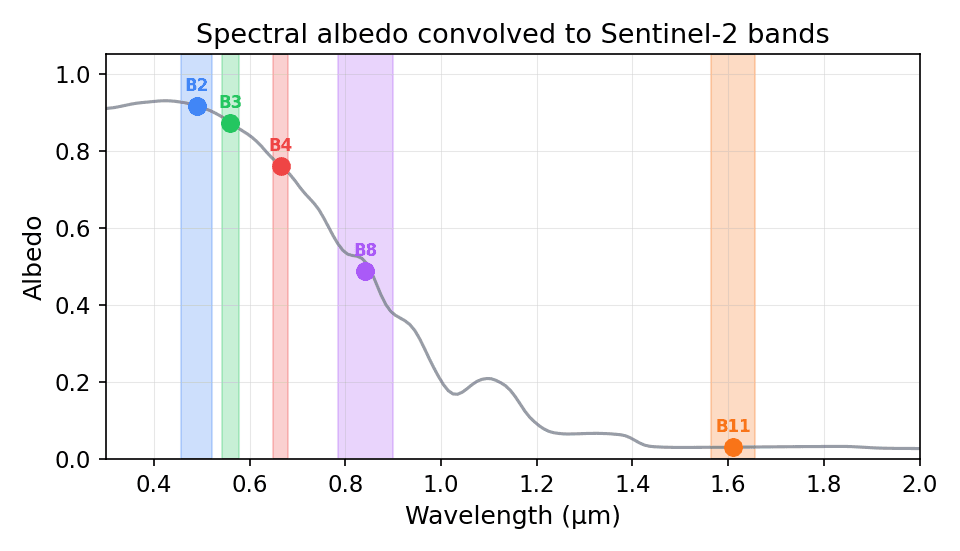
Spectral index calibration
Compute indices across a range of surface conditions:
from biosnicar.drivers.sweep import parameter_sweep

df = parameter_sweep(
    params={"rds": [100, 250, 500, 1000, 2000]},
).to_platform("sentinel2")

print(df[["rds", "BBA", "B3", "NDSI"]])
Multi-platform sweep
df = parameter_sweep(
    params={"rds": [500, 1000]},
).to_platform("sentinel2", "landsat8", "modis")

print(df[["rds", "sentinel2_NDSI", "landsat8_NDSI", "modis_NDSI"]])
Forward modelling for retrieval validation
Predict what a satellite would observe for a given ice configuration:
s2 = run_model(solzen=50, rds=500, black_carbon=1000).to_platform("sentinel2")
print(f"Sentinel-2 B3 (green): {s2.B3:.3f}")
print(f"Sentinel-2 NDSI:       {s2.NDSI:.3f}")